
BLOG OF MAYANK JAIN
10 Years A Poker Player - A Retrospective
What it means to be a professional poker player in India. A look back at my journey. The freedom, the loneliness, the discipline, and shedding a lifetime of impostor syndrome.
For most of my life, I’ve suffered from Impostor Syndrome. The greatest credit I can give to Poker is that it helped me finally shed this malady.
In December 2025, I completed 10 years of playing poker for a living. I played Texas Hold’em cash games online in India. That meant clicking buttons at a desk for hours, playing 6-8 (sometimes more) tables simultaneously, making thousands of decisions per session.
This is a look back on my journey in this crazy, beautiful game as a professional.
The Fully DIY Path
In these ten years, I took exactly one coaching session. One hour. That’s it.
This isn’t a brag by any means. I’m not claiming it’s the optimal path. It almost certainly isn’t. But it’s how I tend to do things - the do-it-yourself mentality. For example, it’s only recently that I realised that I can get a cup of coffee by requesting my wife to make me one.
I had an offer to join a stable. For those who don’t know, a stable is essentially a backing arrangement: someone funds your play, you get coaching and support, and you split the profits. It made sense on paper. But it didn’t align with what I wanted from life. I wanted autonomy, but it felt more like a job.
So I started grinding from the lowest stakes - blinds of INR 1/3 or a buyin of INR 300. Now I play blinds of 500/1k on a 100k buyin table.
The Roller Coaster Inside
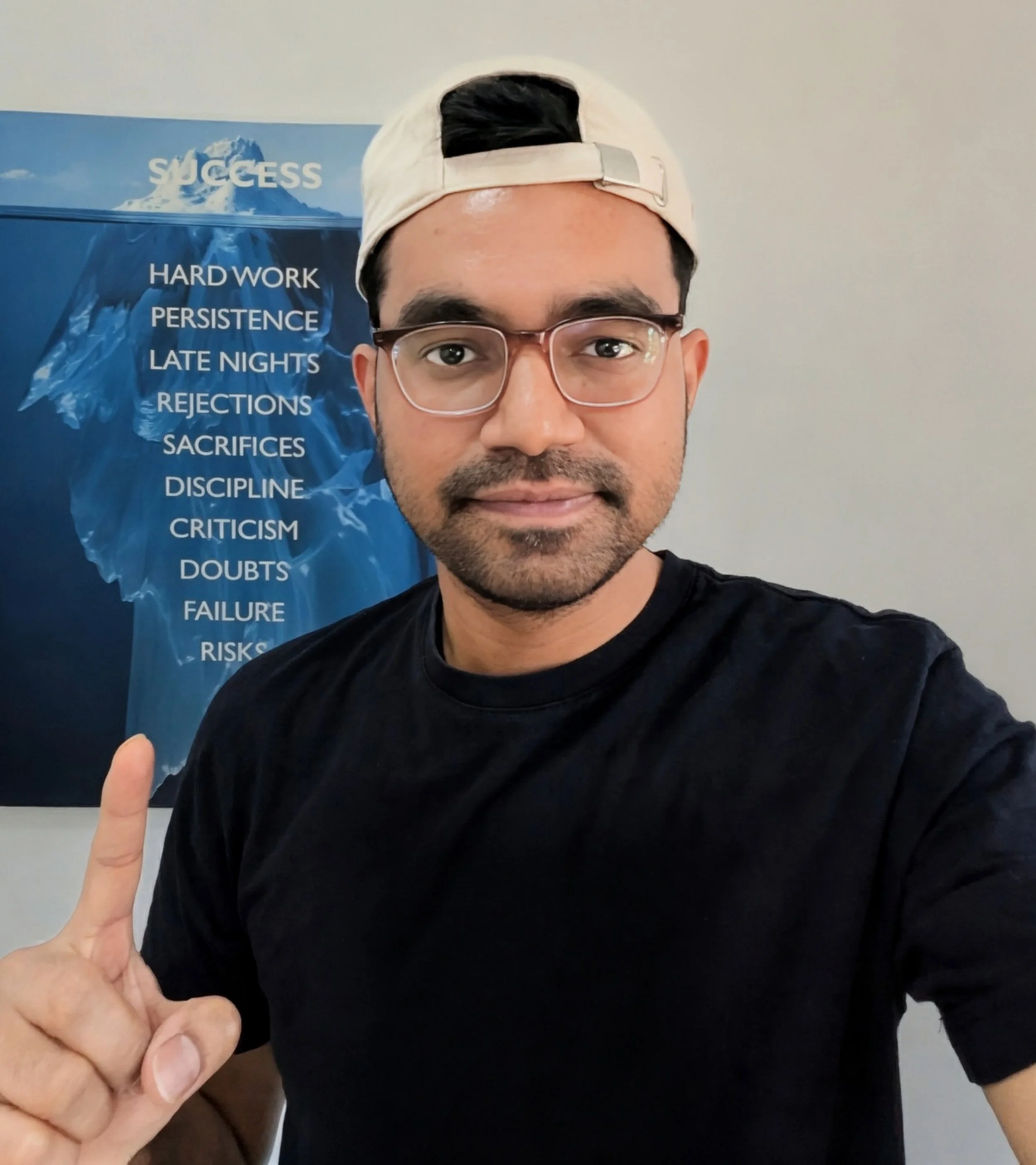
The mindset piece of poker was a wild ride.
This wasn’t my first time taking a risky career choice. Before poker, I’d been an entrepreneur, so I understood risk. I knew the path isn’t linear. But poker is a different beast.
In entrepreneurship, you can at least tell yourself a story about building something. In poker, the feedback loop is brutal, immediate, and often misleading. You can play perfectly and lose. You can play terribly and win. Every session feels like a verdict. Every downswing feels existential. And your brain has to somehow make peace with that.
Many nights I would lie awake wondering whether I’m good enough for the game. Did I make the right choice? Eventually, you have to find stability within, not from results.
So as my career progressed, I found myself spending more time on mindset than on strategy. I hired a mindset coach. Fun fact: Out of all the sessions that I had with my mindset coach, there was only one that I had during an upswing. Every other time was when I was downswinging bad.
The Loneliness
From the outside, life looked incredible: freedom, income, flexible hours, no corporate constraints. But at 2 a.m., when you’ve lost the equivalent of someone’s annual salary in a single session, it can get very lonely.
Who do you call? Who understands?
Poker isolates you inside your own mind. The swings are too abstract and too intense for most people to relate to. It’s only a small group of your poker friends who really get it.
You can’t go to your wife and say, “Hey, I just lost a few lakhs, but it’s fine, it’s just variance.” She didn’t sign up for that kind of anxiety. After a certain point, I stopped sharing my results with her altogether. Compartmentalising became my most important skill. I turned it into a personal KPI: my wife should never be able to tell whether I’ve had a great day or a terrible one. I didn’t want the variance of my profession to become the variance of our home.
The Conflict
I was always conflicted about poker as a way to make money. It's a zero-sum game. Every rupee I won was a rupee someone else lost. It was there when I started. It is still there today.
Eventually, I made peace with it by reframing what poker actually gave me. It forced me to become disciplined, analytical, and emotionally resilient. It allowed me to provide for my family. It created freedom.
It also made me feel ready to become a father. If I could handle this level of uncertainty and responsibility, maybe I could handle raising a human being too.
It allowed me to spend so much time with my baby after he was born. The flexibility that this unconventional career gave me, i.e. being present for those early months without restrictions, was immense. I’m forever grateful to Poker for that.
The PROUDEST MOMENT
My parents didn’t really understand much about Poker when I jumped into it. They were apprehensive, as most Indian parents would be. But they trusted me. Or at least they made peace with it.
They fully embraced it when they saw me on TV during the Poker Sports League (PSL). Appearing on TV was a validation that very few other things could have given. Personally, I didn’t care about it. But my parents were ecstatic. That I did care about. (It helped that MS Dhoni and other celebs had started appearing in poker TV ads.)
Becoming a better version of myself
I remember using a catch-phrase, “Main to chal lunga.” i.e. Whatever it is, I’m up for it. I would be ready for every plan, every outing. That’s not the best strategy if you’re trying to make it in a volatile career. When you have absolute control of your schedule, ironically, less gets done.
Over time, I learnt the concept of Discipline Is Freedom. Also, life threw some curveballs, which forced me to focus on actually making money.
So I started a three-month grind challenge. If I could finish it, there would be an outsized reward at the end of it. I told everyone that I am going underground.
At that time, I was a smoker. After the first month, I looked at my results and realised I wasn’t playing my best. I could feel smoking had a lot to do with it. So I quit smoking. This book helped.
Around the same time, I joined a gym for the first time in my life. And that’s a habit that has stayed with me till today.
The Year Everything Stopped Making Sense
At the end of what had been my best year financially, I felt empty. I wondered, “Now what?”
At the start of the year, I had set a monetary goal. Upon reaching it, I realised that I didn’t really feel anything special. Sure, there was more money in the bank. But was I happier? Or maybe I was just overthinking it. Honestly, I didn’t really know what was going on with my brain.
So I spent the next year stepping back. I read a lot of books. Ancient wisdom. Proven philosophies. Memoirs. Science. I was trying to answer what this life is about, and where I fit in it.
That didn’t give me all the answers. But it gave me a couple of frameworks to lean on in uncertain situations. One is Process over Goal that became the theme of this blog. Second, The Power of Now by Eckhart Tolle. That also inspired my son’s name - Eckarth.
The Coaching Chapter
Somewhere along the way, I started coaching other players for two reasons. First, I wanted to diversify beyond just playing. Second, I wanted to meet more people.
Through coaching, I met CEOs, college deans, government officials, techies, businessmen, and parents who wanted to introduce their teenagers to structured thinking through poker. I saw my knowledge through someone else's eyes. The things I took for granted: reading situations, managing risk, staying rational under pressure, were exactly what these people were hungry to learn. And I realised, I was great at it.
The Impostor Syndrome that I talked about earlier? Coaching had a lot to do with fixing that.
The Catapults
Looking back, growth in poker was never gradual. It came in sudden jumps where everything suddenly shifted up a level.
The first was PSL. Getting selected, learning tournament play, and binking a few big scores following that.
The second was the three-month grind challenge. Going underground, quitting smoking, joining the gym. That period compressed years of discipline into a few months. That helped me both mentally and financially.
The third was coaching. It made me a better player. I was forced to look at every spot much more deeply so that I could explain it to my students in the simplest way possible. I had a visible marker of how far I had come since starting out.
The Road Ahead
Through all of this, a new path has begun to take shape: The Little Rationals. A new chapter I’m building now, that is a culmination of all of my life paths, including Poker, so far.
Poker gave me freedom, resilience, time with my family, and a deeper understanding of myself. It also gave me loneliness, doubt, and existential questions. But I wouldn’t trade it for anything. Through this process, I became someone I respect. And someone who isn’t shy to admit it.
I wouldn’t recommend it to everyone. But for me, it was exactly the journey I needed.
That’s the real lesson for me: the pursuit of a worthy goal and being willing to live with the trade-offs that come with it.
Fatherhood, In Three Timelines
I wrote this piece at three different times: 2 weeks after becoming a father, then after 5 months, and finally 19 months. I have not edited anything out, so hopefully, it gives an unfiltered, clear reflection of my thoughts at the time.
Two weeks of Fatherhood:
I just woke up from a 45-minute afternoon napuccino. It's when you take a coffee before a nap. By the time the caffeine kicks in, your nap is over, and you wake up fresh; none of that post-nap grogginess.
This is one of the longest naps I’ve had in the last two weeks. Most days it’s 15–25 minutes. And more often than not, I wake up feeling recharged to power through the rest of the day (or night). It’s like plugging in your phone at 18% on power-saving mode - twenty minutes later, it’s good to go.
I have always been a good napper. But having a baby, it feels like I have levelled up my napping game.
I can now sleep anywhere, anytime. Twenty minutes till my wife finishes feeding the baby, and it’s my turn to burp and change him? I nap. Earlier, I would’ve spent that time on my phone, which only made falling asleep harder.
The first two weeks of fatherhood have forced me to be present all the time. There’s just one thought running in the background: keep the newborn alive and well; no drifting into an immovable past or an unrealised future.
So there’s no boredom. No craving for instant gratification. No revenge procrastination. Just sleep after long, tiring days.
I’m always moving. Diapers to change. Utensils to wash. Cats to attend to - like right now, as I hear Pippin meowing upstairs after his nap. I give him his due attention. Then it’s time to feed the baby again.
Has it been overwhelming? At times, yes. Especially since it’s just my wife and I taking care of him. We haven’t called for external help (yet). Friends, though, have been life-saving.
Is it rewarding? The baby is alive, healthy, a peeing-pooping machine who hasn't yet developed ways to reciprocate affection. But I don't think I've thought about any reward. Even when I pause to look for it, nothing comes to mind.
Maybe that’s the lesson. Being fully present in the action. That itself is the reward.
5 months of Fatherhood:
It’s 2.30 pm.
I’ve just returned from the hospital. The baby hadn’t peed in about twelve hours - a sign of dehydration and a cause for serious worry. Fortunately, he peed in the paediatrician’s office. I guess he didn’t want to spend a second longer in the hospital than necessary.
I came home and sterilised his teethers. Made coffee - my second shot of caffeine today. I placed him in his bouncer, right next to my work desk.
This isn’t normal. I haven’t really used my work desk much in the last five months.
Nobody told me parenthood would be this tough. Some people did allude to it. I just didn’t think it would be this exhausting, especially since we chose to do most of the work ourselves instead of hiring help.
It does have its rewards.
I now know all my baby’s tickle points. All the funny faces that make him smile. All the tiny cues that tell me what he needs — or what he definitely doesn’t. We go for morning walks - I carry him in a baby carrier. We meet pet dogs, neighbours, and stray cats. It's quite nice.
19 months of Fatherhood:
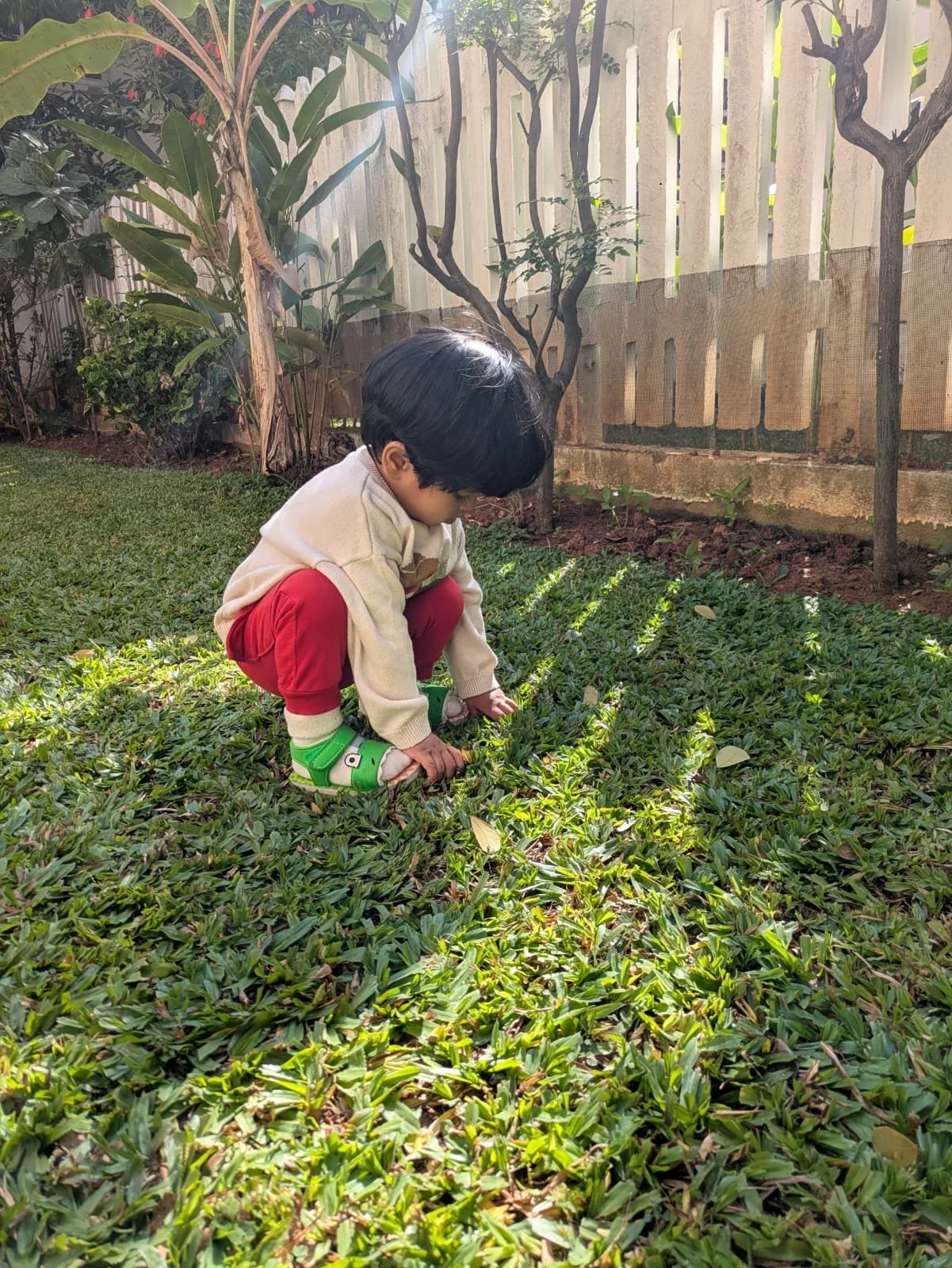
My boy, today.
We have a nanny now. My son is playing downstairs with her. I can occasionally hear his cries and screams and nahin - that's his favourite word. He's a boy after all - he makes his presence felt.
His dependency on me has reduced. I still bathe him every day. He still relies on me for aggressive play - I’m told toddler boys need that. I’m more than happy to oblige.
I still work from home. I take frequent breaks to go see him, to play.
Today, he pulled out a small tub, sat in it, and asked me to push him around the house. And then: “again.” That’s his second-favourite word.
We don’t go on morning walks much anymore. Sometimes I take him to the playground in the evenings. He talks now. Copies everything I say. Has learned how to say “lub you.”
Fatherhood is as exhausting as you want it to be. Or maybe as exhausting as you allow it to be. I’ve been focusing more on work lately. So I've started delegating more around the house, letting my wife take on more of the heavy lifting.
I have no idea how it's going to be in the future. But I’m here for all of it.

Best Book I Read in 2024
This year, I want to recommend just one book—Days at the Morisaki Bookshop by Satoshi Yagisawa. A friend recommended this to me, pitching it as a good book to get back into the reading habit. And that’s exactly what it did.
It’s not a groundbreaking or profound novel—quite the opposite. And therein lies its beauty. It is a simple, easy read that helped me reset my dopamine level and bring books back into my life.
After becoming a first-time father this year, parenting and child-rearing books dominated my reading list. I was at a point where I had stopped reading for leisure simply because finding uninterrupted time and energy was a challenge. Deep-focus came at a premium too. So this book was a blessing in restoring calm to a hectic first year of fatherhood.
I’d highly recommend it.
I hope you have a great new year. Let me know if you have book suggestions for me. Here are the lists from previous years: Best of 2023, 2022, 2021, 2020, 2019, 2018, 2017, and 2016
P.S. If you’re ever looking for parenting book suggestions, hit me up.
Best Books I Read in 2023
Say Aye if you read less this year than the last.
“Aye!” Less than half the books of last year for me.
The short attention span syndrome hit me hard. It’s evident in the fact that two of the books I recommend here are a collection of bite-sized aphorisms.
We all have our different reasons for why that happened. And I hope we agree that it symbolises a more serious disorder. But that's a discussion for another time.
For now, the best books I read this year:
1. The Prophet (Audiobook) - Khalil Gibran
A collection of timeless wisdom. Simple, yet thought-provoking.
2. Kitchen Confidential - Anthony Bourdain
Every year, I read one such kind of book - streams of consciousness written down on paper without any filter. And I love it. This raw writing style is as much fun writing as it is reading.
3. The Bed of Procrustes: Philosophical and Practical Aphorisms - Nassim Nicholas Taleb
Another collection of tiny pearls of wisdom. One thing that I still remember from this book - Taleb hates economists.
Notable Mentions:
Elon Musk - Walter Isaacson
Can’t Hurt Me - David Goggins
River of Stories (Graphic Novel) - Orijit Sen
I hope you do get around to reading some of these. I really do. And if you have some recommendations, please do leave a comment. I want to get my attention span and focus back in 2024.
Lists from previous years: Best of 2022, 2021, 2020, 2019, 2018, 2017, and 2016
Anatomy Of A Bluff
Boom! Boom! Boom!
I empty the clip. A triple barrel bluff. The villain is tanking. My heart is leaping out of my mouth. It's for a lot of money. A month's salary for me at one point in my pre-poker career.
Boom! Boom! Boom!
I empty the clip. A triple barrel bluff. The villain is tanking. My heart is leaping out of my mouth. It's for a lot of money. A month's salary for me at one point in my pre-poker career.
Would he call? Moments earlier I got sucked out by a five-outer. Maybe he thinks I am tilting. But he's a smart player. And I believe he thinks I'm fairly good too. He knows that I know that I appear to be tilting. So I might be less likely to be trying to pull off a huge bluff. Perhaps that's a good reason to do it right now. Who knows what level he is thinking on?
30 seconds of his time-bank remaining. 30 more seconds of me mentally, and sometimes loudly, shouting 'Fold!'. I am playing five more tables. I have important spots on two. I try to make good decisions on them. But I don't spend much time there owing to them being small pots. All my energy is focused on manifesting a fold.
I like my bluff. The board is good for my range. My hand selection is good. And although I don't block his strongest value, I unblock his call twice, fold river hands. I am also at the bottom of my range. So I have to go for it.
15 more seconds. The tension is too much, I take my eyes off this table. Like the footballers who stand with their back towards the goal as their teammate goes to take a shot in the penalty shoot-out.
I look back.
Five more seconds to go. This is not a good sign. If tanked this long, he's more likely to call than fold. If he's thinking logically, he might find a fold. But I'm afraid of the 'Fuck it. I call.'
Two more seconds. I can almost see a 'Call' and 'You Lost' animation coming in the last second. Add to it the embarrassment of having to show the bluff.
'Fold.' Phew! A big deep breath. I take a sip of water and glance a peek at my day's winnings graph.
On to the next hand.
Best Books I Read in 2022 & Getting Better at Reading
My biggest reading accomplishment this year was an improved relationship with books. Here’s how:
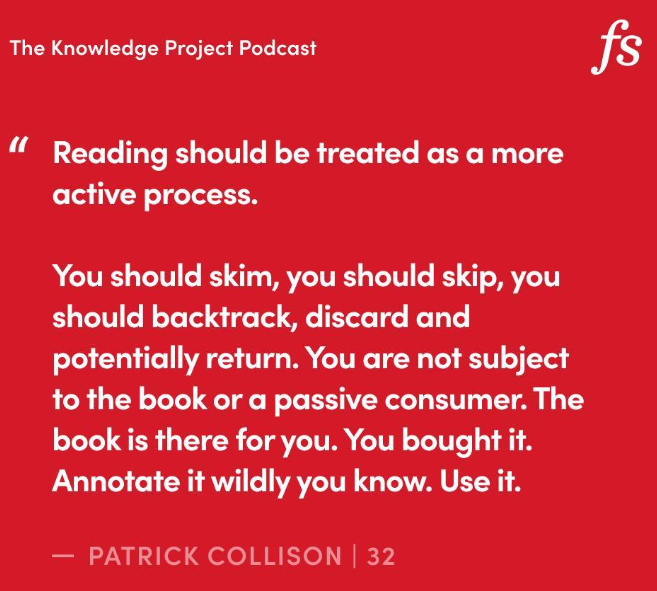
Active reading instead of passive consumption. I tried to make the book work for me instead of the other way around. I got inspiration from this quote on Farnam Street:
Learnt the art of letting a book go unfinished. It would bother me if I didn’t complete a book even if it wasn’t enjoyable. But now I feel much more at ease with that. For instance, I have read 30% of Fairy Tale by Stephen King. But I’ve stopped enjoying the style of narration so I am quitting it.
Letting go of trying to understand every single word/sentence. This is a problem I found especially in sci-fi. The plot would be amazing, and the details immaculate. But the writing style can be dense and full of jargon. They can be difficult reads. So I decided to stop spending too much time worrying about understanding every single detail, and focus on the larger picture instead. Cases in point: Dune series and Brave New World.
Reading what I like and not what I am supposed to like. For example, there was Rumors of Spring - a girlhood memoir by the author who grew up in Kashmir. I wanted to like the book. I wanted to understand what it was like growing up in such a conflicted part of our country. But I just couldn't get into the groove of it.
And now the books I liked the best this year:
1. Breath: The New Science of a Lost Art - James Nestor
Given that breathing is the most fundamental aspect of life, its effects on us shouldn't be surprising. But I was constantly amazed. It's an insightful book which takes a lot of references from our ancient Indian texts and practices (I am looking at you, Pranayam).
2. The Three-Body Problem - Cixin Liu
Originally written in Chinese, the English translation seems a little jagged, especially whenever there is a conversation. Or maybe it's just the cultural difference that caused it. It was after all the first Chinese book I've ever read. Even then, it managed to provoke some vocal outbursts of 'Wow' in me. Immense.
3. The Poppy War - R.F. Kuang
It was a heady combination of fresh air and comfortable familiarity. If you like Harry Potter-style coming-of-age fantasy, you'll love this. A word of caution, the second book in the series was a little underwhelming. I would still give it a read in spite of that. It also gave me my new favourite exclamation - Tiger’s Tits!
4. Quiet: The Power of Introverts in a World That Can’t Stop Talking - Susan Cain
The most important book I read this year. It helped me understand the fundamental difference between the two broad personality types we divide ourselves into - introverts and extroverts. At times, I struggle with too many people or too much stimulation. This book helped me to be at peace with that. Moreover, I learnt some tools to navigate such situations.
Notable mentions:
Ted Chiang's two anthologies were enjoyable.
I also discovered Brandon Sanderson after his incredible Kickstarter campaign which raised more than $41 million for his upcoming books. I enjoyed the new magical world in them.
Seth Rogen's Yearbook was funny. And of course, Atomic Habits is damn good.
I hope you do get around to reading some of these. If you like these recommendations, check out the rest of my reading list here.
Lists from previous years: Best of 2021, 2020, 2019, 2018, 2017, and 2016
If you like this post and want to receive emails on any new post I write, leave your email address here:

Living Carelessly In Goa - The Story of Aai
It rained today in Bengaluru. So I made Maggi and had a cup of coffee. The perfect moment to reminisce about good times. And the 2 years I spent in Goa was as good a time as any. I’ve been writing stories from my stay there and this is the first one I want to share with you all.
AAI
In our Goa house, there was a back exit through the kitchen. We kept it open while sleeping. It was because we didn’t want to be shaken awake by violent knockings on our bedroom window in the morning. Who would do that? Aai.
Aai (pronounced “aaee”) is a cute, loving Goan lady who used to take care of our house in Goa. Her name was Savitri though nobody ever called her that. She was Aai for people of all ages and genders.
It was hard to tell her age. Years of hard labour in the fields under the strong Goan sun had wrinkled her face. She could be anywhere from 45 to 60. She had a frail figure and walked with a slight stoop.
Every morning she came to wash the utensils. We were not early risers and would still be sleeping when she arrived. The doorbell broke and we never got it fixed. So she would knock on our bedroom window vigorously. Knock is a euphemism for what she did. It was an assault. THAK! THAK! THAK! THAK! THAK!
Waking up violently from deep sleep is never pleasant. It felt like my soul left the body briefly to cower in the corner. It didn’t want to be a part of whatever it was that demanded my urgent attention. So we started leaving the kitchen exit door open for her to enter without waking us up. It was better to have a small chance of getting robbed than having your soul depart from you every day.
I lived with my girlfriend (and now wife), Amita at the time. She didn’t speak Konkani and Aai didn’t know Hindi. But I would hear them having a perfect conversation. There were exclamations, laughter and sounds of deep discussions. Nobody knows how.
We could see Aai’s house from our garden. It was a traditional Goan mud house with a thatched roof. She lived there with her sons and daughter. Her daughter Sharmila would come to cook for us. And sometimes bring her 7-year-old son who was fun to hang out with.
Sidenote 1: Thank God we get a second set of teeth as we get older. Because the first set isn’t meant to last given our eating habits as kids. This little boy had more red and black on his teeth than white.
Aai was a workaholic. Apart from our house, she worked at our neighbour’s too. She would come in early at 6. Then after finishing work at both the houses, she headed out to work in the fields. Depending upon the season, it would be either rice or mango fields.
I never saw her eat. Her fuel of choice was a cup of black tea with a borderline unhealthy amount of sugar added. That and tobacco which she preferred chewing.
Sidenote 2: She brought us the most delicious mangoes from the fields. No exaggeration. I never had better mangoes before or after. And I’ve had plenty. Ask my mom. Or my wife who is still angry about the time I ate the last mango in the house which was apparently hers. (I showed her the draft of this story - she questioned the word “apparently”. In her mind, it’s“definitely.”)
Aai was a badass. Our neighbours’ dogs were ferocious. They were guard dogs and wouldn’t let anyone near the street. The only person they were afraid of was Aai. They considered her the Alpha. Even the most aggressive among them - Rover, a German Shepherd, conceded before her.
Aai enjoyed pyromancy. Instead of letting me dispose the garbage bags in the designated area, she preferred burning it all.

Aai in our garden doing her thing
Aai had direct contact with the Gods. We visited her house once for a religious function. I asked someone what that deity is. They said it is the Goddess that possesses Aai during the festival. It was said casually as if it’s a normal thing to happen.

It’s the one on the left
Aai was loving.
One time Sharmila burned her hand in her kitchen. So she couldn’t come to cook for us. Coincidentally, Amita was away in Dehradun. So I had to do my own cooking.
Now, remember that this was Goa in 2017/18. There was no Swiggy or Zomato to order from. There was one Pizza shop that delivered to our place. There used to be two but then our neighbour’s dog bit one of the delivery guys. There was an attempt to bite the other guy too, but he escaped. One other restaurant delivered but he would drop the food a kilometre away. He would call and I had to go and pick it up. In short, it was tedious to order in. So I usually ate out or chose takeaway for dinner. And I made the same stuff for lunch every day - Dal and Chawal.
Aai would notice the lack of dirty cooking utensils in the morning. So she felt that either I am not eating enough or consuming a lot of outside junk. Couple it with the fact that she would see lots of empty beer bottles in the morning. She figured that I was not in a good way.
A few days later, I found Sharmila at the door. Her hand was still healing and she was in no condition to cook. Aai had commanded her to go and check on me. ‘Baba is not eating,’ Aai had told her. I felt my soul shed a happy tear. All that cowering in the corner was worth this wonderful person. I assured her that I am OK, even if I wasn’t. And that she should come back only when she is completely healed.
Aai called me Baba. ‘Good morning Baba’, and ‘Good morning Aai’ were the extent of our conversation. But it was enough. During those days while Amita was away, I went through a bout of depression. It was fueled by lots of alcohol, cigarettes, and loneliness. Reading Charles Bukowski didn’t help either. Having Aai around to share a smile and a few words were like a balm. On many days, these were the only words I spoke and hers was the only face I saw.
She always seemed happy. Her red-stained teeth betrayed her tobacco habit but took nothing away from her infectious smile.
Aai made our life better.
Thanks for reading. Did you enjoy this? Do you think I should write more Goa stories? Let me know. I would love to hear your thoughts.

How To Be Bored
Epic boredom triggered most of my attempts to finish this article. Today, it happened when I threw away my phone in disgust after mindless Instagram scrolling.
Earlier, I read three books on my kindle for five minutes each. Then switched to a paperback, which I gave up after 10 minutes.
I wasn’t having fun. Skipping from one thing to another is not enjoyable. So why was I doing it?
Simple answer - I was bored.
Complicated answer -
I wanted to change the current moment to a more desirable state
The desirable state itself is an abstract that I was not sure about
It means it is stemming from the discomfort of the present. And we have conflicting ideas about how to change that situation.
If you’re like me, you want to be productive yet also to have fun. Learn a language and also watch a movie. You want adventure but also peace and quiet. A little contentment won’t hurt either.
Ultimately, it comes down to a single thing summed up perfectly in this quote by Blaise Pascal:
“All of humanity’s problems stem from man’s inability to sit quietly in a room alone.”
How do we solve this?
Slow everything down
The Idea
Take the mundane everyday activities - brushing teeth, folding laundry, washing hands, etc. Instead of rushing through them to get them over with, slow down. Do them for their own sake. Remind yourself that life is every second that passes. It’s not happening in future, it is in every moment.
How It Works
The default modus operandi during such actions is auto-pilot. Our muscle memory gets the job done. So the mind wanders. Uncontrolled, it takes us to memories or hypotheticals - good or bad. What if we turn off the auto-pilot for a bit?
The cheap dopamine that we get from our screens has hampered the capacity of our minds to find creativity and joy in the ordinary. If finding joy seems ambitious, simply being able to get through a day without a constant need for excitement is a big win.
My Experience
The other day, I was rushing down the stairs. Halfway through, I had this realisation that I didn’t need to be anywhere. So I slowed down and brought my focus to the present. It was like coming out after living inside my own head for a long time. It sounds silly, but it was liberating.
“Do the dishes to do the dishes” - Thich Nhat Hanh
Staring into the distance time
The Idea
Give yourself an unbound slot of time to just sit and stare into the distance.

How It Works
If you’ve been practising slowing down the mundane, then now is the chance to give free reigns to your mind. Follow where it goes. Then gently manoeuver it in the direction you want - towards things that you value.
Great things happen when you let your mind wander in a controlled fashion. You go deeper, into the first principles of things. It gives you a chance to focus on the important things in life - whatever that may be for you in that moment.
The best advice you’ll follow is when it comes from within. And this time gives you some empty headspace to listen to that voice.
My Experience
I use this technique to come up with new articles. I sit in silence, look into the distance and observe my life at that time. That time could be that month, or week, or that particular day. And new ideas emerge from that. Sometimes, it is just about that instant; this post came from analysing the discomfort of the moment.
Staring into the distance helps me improve the relationship of my mind and self. It gives me the feeling of more control over my own mind rather than the other way around.
Day of meditation
The Idea
By meditation, I don’t mean sitting on a cushion, closing your eyes and focusing on your breath. Although if you can do that, it's great. I mean making the whole day as an exercise in meditation. Look beyond the obvious in things.
How It Works
Take an example of the vegetable you are preparing for a meal. Unless it’s from your kitchen garden, its journey from a seed to your kitchen has been extraordinary. It was nourished by a big ball of fire millions of kilometres away. It was germinated by a tiny bee. And it took an advanced human-built infrastructure to get it to you unharmed.
Take a minute to appreciate this minor miracle. You might find more gratitude for the simple things in life.
My Experience
You can try this technique right now. Slow down and imagine the writer penning down these words. At which point must I have stopped to brood. Or which words were perceptibly difficult to write down. Look beyond the screen and into the mind of the author.
I do this with music. While listening to a song, I would try to decipher the different beats. And then imagine in what sequence the composer must have arranged it.
Two More Techniques
Find Your Centre
Find one thing that centres you. Breathing deeply, music, gratitude - whatever it may be. For me, it’s reading a few Zenhabits articles. It always calms me down.
Romanticise The Present Moment
Let’s say you are peeling an orange in the kitchen. Imagine reading your biography and that moment described by a talented writer.
"... was standing there in the kitchen after a day of work. He stood there peeling an orange skin listening to music. This was a ritual to him. The act of peeling was like taking off a layer of burden after returning home...."
I love this technique. It attaches romance to every moment of my existence. Living life becomes a performance - in a good way. You become the star of the show. Indulge in the moment, and I daresay, you’ll feel larger than life itself.
More about this technique in Romantic’s Guide to Finding Focus.
How to do weekends
On Recovery And Relaxation
Without the meaning found in the structure of weekdays, a weekend becomes difficult for me. On a Saturday afternoon, unrest of not knowing what to do starts brewing.

A weekend
Free time on the weekend -> potential for boredom -> mind at unease.
And since a weekend relaxation powers our battery for the week ahead, it becomes critical to recovering well.
We recover the best when we stay in the present moment - unattached from past regrets or future worries. The central idea of the aforementioned techniques is to help you do that. I hope they come in handy.
I would love to hear what you think about this.
Be bored better. Have a great weekend.
If you like my writing, leave your email address here so that I can let you know whenever I write something new.
Further Reading:
Read my most popular articles
Photos by: Jaël Vallée, Abhay Singh and Juan Rumimpunu on Unsplash
Building a Meditation Habit - Atomic Habits Style
For the last two weeks, I have tried building a meditation habit. The previous attempt didn’t sustain for long. Turns out that sitting quietly for 15 minutes every day with your eyes closed and not thinking of things is incredibly difficult. So this time I applied James Clear’s methods from his book Atomic Habits and tried to build a system around it.
“If you’re having trouble changing your habits, the problem isn’t you. The problem is your system. You do not rise to the level of your goals. You fall to the level of your systems.”
Why do I care about meditation? For the simple reason that I feel better after. In my work as a poker player, I need to make a lot of quick decisions repeatedly for hours. And whenever I played after meditating, I felt like I had just a wee bit more time for every decision. There’s also plenty of science behind its benefits. Our brain physically changes as we meditate, especially in the parts involved in monitoring our focus and self-control.
Now, on to the methods. I am going to use a lot of examples of exercise as a habit because that’s something I’ve become good at. Direct quotes from the book in Italics
CHANGING THE IDENTITY
The ultimate form of intrinsic motivation is when a habit becomes part of your identity.
When I tried to quit smoking, I read Alan Carr’s Easy Way to Stop Smoking. One of its two key points was to believe you are a Non-Smoker. Not that you have quit, or you are someone who smokes sometimes. But you are a non-smoker.
It’s like being a Vegan. Either you are, or you are not.

Similarly, if you want to create a new habit, you have to become that person. For me, if I am trying to build a meditation habit, I have to start thinking that this is what I do - I meditate daily. There is no I have to or I should. It’s natural.
The word ‘Identity’ itself comes from two Latin words Essentias meaning being and Identidem meaning repeatedly. So our identity is nothing but our repeated beingness.
THE 1ST LAW: MAKE IT OBVIOUS
The Techniques:
The Implementation Intention or The Trigger - It is a plan that we make beforehand about when and where to carry out the activity. The format is:
I will [BEHAVIOR] at [TIME] in [LOCATION]
Habit Stacking - Have you ever noticed yourself going on a shopping spree? That tendency of one purchase leading to another is called The Diderot Effect. Habit Stacking capitalizes this tendency by using an existing habit as a trigger for the desired habit:
After [CURRENT HABIT], I will [NEW HABIT].
Environment > Motivation - Redesigning our environment does much better to change our behavior than Motivation (which is an exhaustible resource). Two key points in this:
Use visual cues as catalysts for the new behavior
Try a new place where you haven’t tried the habit before.
My Adaptation:
In the last year, my exercise habit was triggered by setting the dishwasher. It was a specific and actionable trigger. For meditation, my trigger would be finishing lunch. Post-lunch is often the period when I am most lethargic. And feeling the lowest during the day. Meditation can hopefully help solve both problems.

Adding Meditation just after Lunch
For the environment, I am going to use my balcony which already has a Buddha painting hanging there. The combination of a new place plus the visual cue should do its job.
My Trigger + Habit Stacking:
‘After I finish lunch, I will meditate on the balcony for 15 minutes.’
THE 2ND LAW: MAKE IT ATTRACTIVE
The Techniques:
Temptation Bundling - Using a habit that we are tempted to do as a reward for an activity we should do. The anticipation of our WANT habit drives the NEED habit. For example, I browse Twitter in breaks between sets during my workout. The Formula:
After [HABIT I NEED], I will [HABIT I WANT]
The Effect of People - I took up Intermittent Fasting because I had a friend who did it successfully. That same friend quit smoking after I did. The people in our lives affect our habits immensely.
One of the most effective things you can do to build better habits is to join a culture where your desired behavior is the normal behavior. The shared identity begins to reinforce your personal identity.
Motivation Ritual - It’s like putting on music before a big game/an exam/a workout (all of which I do). Even if you are not motivated beforehand, the ritual itself drives the motivation up.
My Adaptation:
Combining Temptation Bundling with Habit Stacking:
After Lunch, I will meditate for 15 minutes on the balcony
After Meditation, I will make a cup of tea and have Monaco
As for having people around, I don’t yet have a meditation partner per se. So if you would like to share some insights, I’d love to hear. Meanwhile, I am also going to hang around on Reddit Meditation subs.
THE 3RD LAW: MAKE IT EASY
The Techniques:
Walk slow, not backward - Not being able to do a complete workout every day is fine as long as we do at least a little bit - say 5 push-ups. As long as we put in a rep, however small, it works. Lost days hurt more than successful days help. So maintaining a streak is critical.
One of the most common questions I hear is, “How long does it take to build a new habit?” But what people really should be asking is, “How many does it take to form a new habit?” That is, how many repetitions are required to make a habit automatic?
Habits form based on frequency, not time.
The law of least effort - Prime your environment for future use. Like keeping your morning workout clothes out the night before. Two more ideas:
2-minute rule - Downscale your habits until they can be done in two minutes or less.
A commitment device - Like buying a better mattress for sleeping. Or signing-up for an automatic savings plan.
My Adaptation
I am not looking to meditate 30 minutes every day. I’ll start small for 15 minutes. Even 5 minutes will work.
Usually, after lunch, I lie down for a bit. So I can squeeze in a quick meditation then. Either I’ll be gone into a siesta or I’ll be able to meditate - both reasonable outcomes.
As for priming environment, I don’t need it right now. But if the habit doesn’t work, I will buy a meditation cushion, or a candle or a meditation bowl.
THE 4TH LAW: MAKE IT SATISFYING
The Techniques
Instant Gratification - Our brain is wired to be biased towards immediate reward than by the possibility of even a bigger reward in the future. Hence we need to feel immediately successful for a habit to stick - even if it’s in a small way.
The key is to select a reward that reinforces your identity rather than conflicts with it. So don’t reward yourself with ice cream after a workout. Instead, allocate money for a weekly massage. It reinforces the identity as someone who takes care of their own body.
Habit Tracking - What doesn’t get tracked, doesn’t get done. The habit stacking + habit tracking formula is:
After [CURRENT HABIT], I will [TRACK MY HABIT].
My Adaptations:
My cup of tea + Monaco biscuits serves as Instant Gratification. If it doesn’t work, I will consider creating a Spa fund or Travel Fund.
I use Insight Timer which automatically tracks my habit
Parting Notes
“Men desire novelty to such an extent that those who are doing well wish for a change as much as those who are doing badly.”
I have to remind myself to fall in love with the boredom of doing the same thing over and over again. To look for novelty in repetition. It is an opportunity to delve deeper inside our own minds. It can even be therapeutic - like a runner, putting one step after the other in endless laps.
Hope this was useful to you. If you like this article and want to hear more from me, you can leave your email address below. I’ll let you know whenever I write something new.
Read more articles here or go to the Start Here section if you’re new to the site.
First Of The Day
When I woke up this morning, I had no intention of sending you this article. The idea had not even occurred to me. What happened was that after waking up, I made myself a cup of coffee and started journaling. Nothing ground-breaking right? Except that it is. Allow me to explain.
For the last couple of years, my days have all begun in a similar fashion. After freshening up, I open my balcony door, unroll a yoga mat, and exercise. It is a habit that I've cultivated with a lot of effort and I've seen results (like losing 10kgs or running my best ever 5k which happened yesterday!). Skipping it and doing something else today is a big deal for me. Because that means that I am risking breaking a great habit. Why am I doing this?
It's because of Change in Focus.
Earlier, the focus area of my life was getting fitter and healthier. So I would plan my day around it. That would mean exercise in the morning, long evening walks, and planning meals for the day in advance. I would do my work in the time gaps available instead of the other way around.
I’ve become good at this habit. I genuinely love the process of working out. It has become my unconscious competence*. But now I want to shift my focus towards something else, hence the change.
*Sidenote: Four levels of competence are: Unconscious incompetence, conscious incompetence, conscious competence, and unconscious competence. When we learn a new skill, these are stages we cross until it becomes a natural part of us.
After 5+ years of playing poker professionally, I am now exploring new areas - writing being one of them. For that, I need a clear block of uninterrupted time to do deep work. So today when I woke up, that was my number one priority. Hence the early morning journaling.
I call this First of the Day - Do the most important thing in your life first thing in the morning. And by most important, I mean the singular area of focus in your life. It is by no means a new concept. But getting to discover it yourself sure is a revelation.
Examples of focus areas and how you can use this:
Learning - Start your day with a non-fiction book. Take out 30 minutes for it.
Mental Health/Mindset - Start with art. Meditate. Journal.
Relationships - Take an early morning walk with your person. Discuss your dreams - both literal and figurative. Cook breakfast together.
Exercise - Do it first thing, before checking your phone. Do it before breakfast (I've been working out on empty stomach for years now. It's tough at first, but you get used to it. Have a banana or an apple if you want).
Health: Plan your meals for the day. Cut all the veggies and fruits beforehand. Take action when you are fresh so that you don't give in to temptations when your willpower (and glucose) is low later in the day.
We are not doing this just to get it over with. It is so that our well-rested brain can work to make the subliminal connections that might otherwise be missed when we are exhausted.
By the end of the day when we are tired, it requires more bending of will to do the same thing. Take this article for example. I wrote the first draft in one smooth stretch of time in the morning. But then it took me a tremendous amount of effort to edit and make a finished product later in the day.
Recognizing our peak performance periods and slotting the most important work in that time is a crucial skill. And I've found that doing this just for 2 weeks can be enough to move it from conscious incompetence to conscious competence.
Let me know if it works for you. And if you want to hear more from me, leave your email address below so that I can let you know whenever I write something new.
What it means to be a professional poker player in India. A look back at my journey. The freedom, the loneliness, the discipline, and shedding a lifetime of impostor syndrome.